
What California’s governor race reveals about Toronto’s media-driven political future
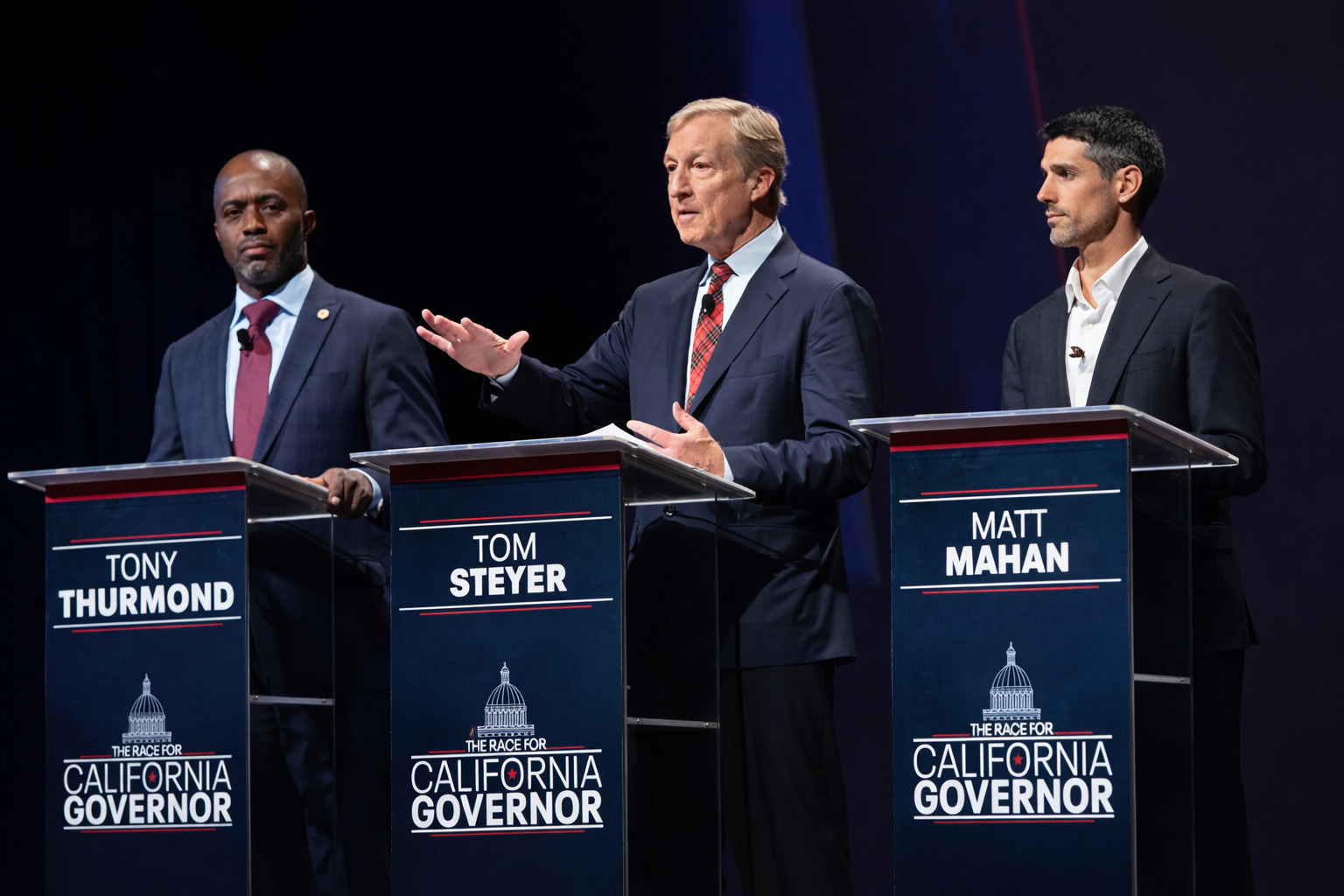
In most election cycles, California already attracts outsized attention. In 2026, that attention has become even more intense because the race to replace term-limited Governor Gavin Newsom is turning into something larger than a state contest. It is becoming a test case for how media exposure, fundraising thresholds and a fragmented field can shape political outcomes long before voters reach the final ballot. Under California’s “top-two” primary system, all candidates appear on the same ballot and only the two highest vote-getters advance, regardless of party. That creates a real risk in a crowded race: if one side is split and the other is consolidated, the final contest can look very different from the state’s underlying political identity.
That is why CNN’s decision to host a statewide gubernatorial debate matters beyond television programming. The debate is scheduled for May 5, with participation tied to meeting defined fundraising and polling thresholds. In a field crowded with Democrats and at least two serious Republicans, those criteria do not simply measure viability — they help produce it. A candidate who qualifies gains national exposure, legitimacy and momentum. A candidate who falls short risks looking marginal even before the first votes are cast.
Donald Trump’s endorsement of former Fox News host Steve Hilton has sharpened that dynamic. Reuters, AP and other U.S. outlets report that the endorsement is widely seen as a way to consolidate Republican support behind Hilton in a race where Riverside County Sheriff Chad Bianco had also been competing for the same lane. In a top-two system, that kind of consolidation matters enormously. It can reduce the chances of two Republicans eliminating each other and increase the likelihood that one emerges cleanly into the general election. At the same time, Democrats are still spread across multiple recognizable names, including Eric Swalwell, Katie Porter and Tom Steyer.
What matters here is not the size of support, but its distribution.
In top-two primary systems, electoral outcomes are often determined long before majority consensus emerges. Historical voting data from statewide races in California shows that when more than six competitive candidates are present, the threshold required to advance can drop below one-third of the total vote — not because support is weak, but because it is fragmented across overlapping constituencies.
This creates a structural asymmetry. A candidate backed by a consolidated bloc does not need to expand rapidly; they only need to remain stable while others divide the same electorate. In contrast, fragmented fields face internal competition that effectively suppresses their own aggregate strength.
Early 2026 polling reflects this imbalance. While multiple Democratic candidates operate within similar voter segments, none consistently separates from the pack. Republican support, by comparison, is beginning to compress around fewer options — meaning that shifts in endorsement, visibility or debate access do not just influence momentum, but can reconfigure the entire competitive field.
Initially, it plays like a familiar American narrative — shaped by Trump, media visibility and high-profile candidates. But beneath that surface, the structure of the race starts to echo dynamics that are already taking shape in Toronto.
Toronto does not have California’s top-two primary. Ontario also does not elect provincial leaders through an identical system. But the underlying mechanics are strikingly similar: when one ideological camp becomes fragmented and another is more disciplined, the advantage shifts toward the side with clearer consolidation, stronger media visibility and a simpler electoral message. The institutional format changes. The political logic does not.
That is where the Toronto angle begins.
The political market in Toronto has repeatedly shown that fragmented fields reward candidates who can dominate attention and hold a coherent voting bloc together. In the 2023 Toronto mayoral by-election, Olivia Chow won with 269,372 votes, or about 37.17 percent. Ana Bailão followed with 235,175 votes, while Mark Saunders, Anthony Furey, Josh Matlow and several others split the remaining vote. The final result was not defined by majority consensus so much as by how support was distributed across a crowded field.
That same pattern appears at the provincial level. In the 2025 Ontario election, Doug Ford’s Progressive Conservatives won re-election with roughly 43 percent of the vote, while the Liberals were around 30 percent and the NDP around 19 percent. Those numbers matter not only because of who won, but because they show how a divided opposition can still leave a governing party in a strong structural position even without overwhelming majority support in the popular vote.
This is the real bridge between California and Toronto. The lesson is not that Toronto is becoming California. The lesson is that modern urban politics increasingly rewards three things at once: media reach, message discipline and vote concentration.
The CNN debate in California shows how media institutions are no longer just covering campaigns. They are helping define who counts as a serious contender. When debate access depends on fundraising and polling thresholds, the gatekeeping function becomes more explicit. The same candidate can look viable or invisible depending on who gets the platform and when. That does not mean the media “choose” winners in a crude sense. It means the architecture of exposure has become part of the competition itself.
Toronto’s media environment is less theatrical than the American one, but it is moving in the same direction. In large urban races, candidates now compete not only for votes but for narrative dominance: who gets booked, who gets clipped, who gets framed as rising, serious or electable. In that sense, local politics is no longer separate from media logic. It is organized through it.

This has practical consequences for Toronto in at least four areas.
First, it raises the value of the “media-ready” candidate. California’s race became more nationally legible the moment Steve Hilton could be described as a former Fox host with Trump backing. The political profile was instantly marketable. In Toronto, the candidates most likely to break through are increasingly those who can function as communicators before they prove themselves as coalition-builders. The campaign becomes easier to package when the candidate already fits a recognizable media frame.
Second, it increases pressure on ideologically similar candidates to clear the field. One reason California Democrats are worried is not that Republican support is larger than Democratic support overall, but that Republican voters may now be more efficiently organized behind Hilton after Trump’s endorsement. AP notes that some Democrats had feared the top-two format could even produce a Republican-versus-Republican general election if the Democratic side remained too splintered. Once that possibility becomes visible, the strategic conversation changes from persuasion to consolidation.
Toronto understands that pressure well. The moment a race becomes crowded, questions shift quickly from policy to arithmetic: who is splitting whose lane, who should withdraw, who benefits from ideological overlap, and whether voters are choosing their favourite candidate or simply the most viable one. That is no longer an exception. It is the default language of competitive city politics.
Third, it makes elections more personalized and more performative. California’s governor race has national importance partly because California is the largest U.S. state economy and a major centre of progressive policy experimentation. The office carries symbolic weight beyond Sacramento. As a result, the campaign is being narrated through personalities, endorsements and televised confrontation as much as through governing detail.
Why does a city election start to feel national?
Because in Toronto, it already does. Housing, transit, affordability — these are no longer local topics. They’ve become signals of broader political competence.
So what changes?
Campaigns shift. Less explanation, more positioning. Visibility starts to matter more than depth.
Who actually competes?
Not every candidate equally. Those with funding, media access and recognition move to the center. Others remain on the ballot — but outside the main narrative.
And that’s the point.
This isn’t just an American story.
It’s a preview of how urban elections start to work when visibility defines viability.
The softest way to put it is this: Toronto’s political market already contains many of the same incentives. Candidates must be visible before they are persuasive, legible before they are nuanced, and strategically positioned before they can afford to be ambitious. Once a race becomes fragmented, the system begins rewarding discipline over breadth and consolidation over enthusiasm.
California makes this visible in real time.
Not as theory, but as structure. A crowded field, uneven exposure, strategic endorsements — and suddenly the outcome is shaped less by preference than by distribution.
Toronto doesn’t run on the same system. It doesn’t need to.
The mechanics are already there. Attention concentrates. Candidates overlap. Visibility defines who is taken seriously long before the vote begins. Some campaigns expand. Others simply cancel each other out.
What looks like competition is often compression.
California is just showing the mechanics in a louder, more accelerated form.
And that is exactly why Toronto should pay attention. The question is not whether local politics will become identical to U.S. politics. It will not. The question is whether the same pressures — media gatekeeping, donor thresholds, vote fragmentation and candidate branding — are quietly reorganizing how urban democracy works.
They are.
The California governor race simply makes the pattern impossible to ignore.
Daniel Hughes
Sustainability & Policy Correspondent
Daniel is interested in how environmental policy translates into real urban change. He specializes in sustainable mobility, climate-focused city planning, and the political frameworks behind transport systems. His writing brings together data, policy analysis, and on-the-ground impact, offering a clear view of how sustainability initiatives affect everyday urban life.
Advertise With Toronto Union 24
Reach over 500,000 engaged Canadian readers monthly. Premium placements available for Q2 2026.
Learn More Liam Carter
  Aila Kenuak