
Ottawa holds firm on climate standards as Alberta pipeline talks miss deadline

As a key deadline passes without agreement, tensions between Ottawa and Alberta are revealing a deeper conflict at the heart of Canada’s energy transition—one that goes beyond pipelines and into the structure of climate policy itself.
Federal officials have made their position clear: environmental standards will not be weakened to accelerate pipeline approvals. But with negotiations over carbon pricing and carbon capture still unresolved, the question is no longer just about regulation—it is about whether Canada can align economic ambition with climate commitments under growing political and industrial pressure.
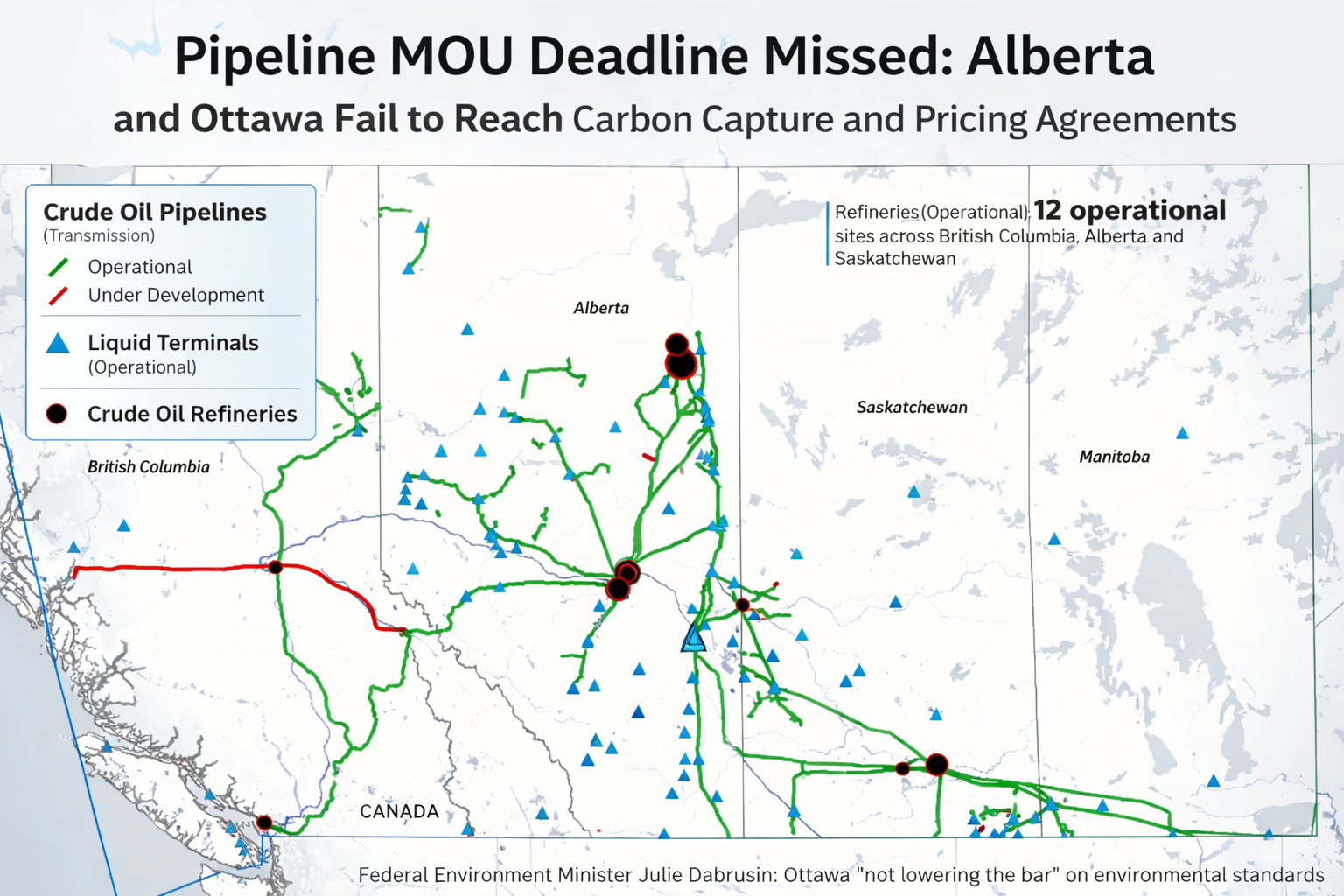
A deadline missed, but not the stakes
Negotiations between the federal government and Alberta were expected to produce agreements on carbon pricing, carbon capture, and regulatory alignment ahead of a critical memorandum of understanding (MOU) deadline. That deadline has now passed without a full deal.
At the center of the discussion is the proposed expansion of pipeline infrastructure tied to oil sands production. However, Ottawa has linked any future pipeline approval to strict environmental conditions, particularly the implementation of large-scale carbon capture systems.
This condition is not symbolic. It is structural. According to the framework under discussion, projects like the Pathways Alliance carbon capture initiative are considered a prerequisite for any new pipeline development.
Carbon capture as both solution and bottleneck
Carbon capture, utilization and storage (CCUS) has been positioned as the technological bridge that allows continued fossil fuel production while reducing emissions. In Alberta, this approach is already partially operational.
Projects such as the Alberta Carbon Trunk Line are capable of transporting up to 14.6 million tonnes of CO₂ annually, connecting industrial emitters to storage sites. Meanwhile, facilities like the Quest project have demonstrated the ability to capture around one million tonnes of CO₂ per year, though with efficiency limits and partial coverage of emissions sources.
Yet scaling this infrastructure to meet national climate targets remains uncertain. Industry groups argue that without stronger financial incentives—such as tax credits covering up to two-thirds of capital costs—projects may remain economically unviable.
This creates a paradox: the same technology required to unlock pipeline expansion is also the factor delaying it.
The economics of uncertainty
Behind the policy debate lies a financial reality. Estimates suggest that up to $40 billion in low-carbon investment depends on the outcome of these negotiations.
For investors, uncertainty functions as a hidden cost. Delays in carbon pricing agreements, shifting regulatory signals, and unresolved federal-provincial tensions all contribute to hesitation in committing capital.
This is particularly sensitive in a global context where competing jurisdictions—especially the United States—are pursuing more flexible regulatory environments. Industry stakeholders argue that higher carbon costs in Canada risk undermining competitiveness, especially when only a minority of global emissions are subject to similar pricing mechanisms.
Federal stance vs provincial pressure
Alberta’s position reflects a different set of priorities. The province has consistently argued that rapid increases in carbon pricing—targeted to reach around $130 per tonne—could discourage investment and slow economic growth.
From Ottawa’s perspective, however, maintaining strict environmental standards is not negotiable. Federal officials have emphasized that any new energy infrastructure must align with Canada’s long-term net-zero targets.
This divergence is not simply political. It reflects two competing timelines:
Industrial timelines, which require long-term certainty and stable cost structures
Policy timelines, which are increasingly driven by climate urgency and international commitments
When these timelines misalign, negotiation becomes less about compromise and more about sequencing—what happens first, and who absorbs the risk of delay.
Pipelines as a proxy for a larger conflict
The pipeline debate itself is, in many ways, a proxy for a broader structural issue. Canada is attempting to simultaneously expand energy exports, reduce emissions, and maintain global competitiveness.
Previous agreements between Ottawa and Alberta have already shown how fragile this balance is. Efforts to stimulate energy investment have included rolling back certain environmental measures while reinforcing others, triggering both political backlash and industry support.
The current negotiations continue this pattern. They are not simply about approving a project—they are about redefining the rules under which such projects can exist.
What happens next
Despite the missed deadline, both sides indicate that negotiations will continue. Alberta has signaled intent to move forward with pipeline proposals, potentially submitting plans by mid-year.
At the same time, federal officials are focused on ensuring that any agreement maintains credibility within Canada’s climate framework.
The risk is not immediate failure, but gradual misalignment. If agreements are delayed too long, capital may shift elsewhere. If standards are reduced, climate targets may become less credible. If both happen, Canada risks losing ground on both fronts.
A system under pressure
What this moment reveals is not a breakdown, but a stress test.
Canada’s energy strategy is being forced to operate across multiple constraints:
economic competitiveness
environmental accountability
political coordination
technological feasibility
Each of these factors pulls in a different direction. The pipeline negotiations simply make those tensions visible.
Conclusion
The missed deadline between Ottawa and Alberta is not the story—it is the signal.
What is unfolding is a structural negotiation over how Canada builds, regulates, and justifies its energy future. Carbon capture is no longer just a technology. Pipelines are no longer just infrastructure. Both have become instruments in a larger system trying to reconcile growth with constraint.
Ottawa’s refusal to lower environmental standards suggests one thing clearly: the next phase of energy development will not be defined by speed alone.
It will be defined by whether the system itself can hold together under pressure.

Noah Bennett
Cycling Industry & Tech Writer
Noah is passionate about the mechanics behind movement — from bike engineering to emerging mobility technologies. He covers innovations in cycling equipment, e-bikes, and urban transport solutions, combining technical understanding with real-world usability. His articles explore how technology is reshaping everyday transportation and redefining the future of city commuting.
Advertise With Toronto Union 24
Reach over 500,000 engaged Canadian readers monthly. Premium placements available for Q2 2026.
Learn More Liam Carter
  Aila Kenuak