
How to Start Bike Commuting for Beginners
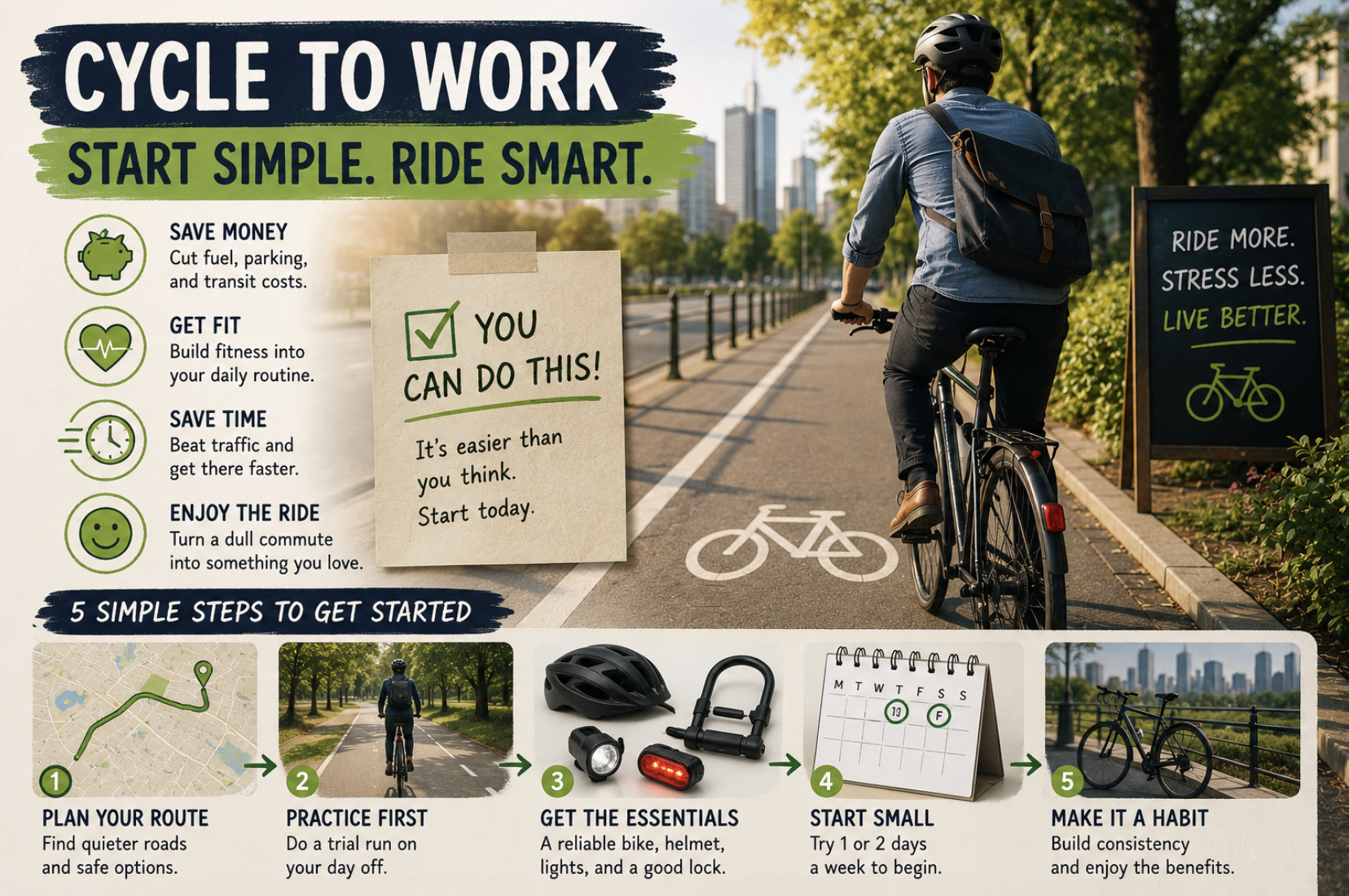
To start cycling to work, begin with a realistic route on quieter roads, do a practice ride on a day off to learn the way and timing, get a few essentials (a reliable bike, a helmet, lights, and a lock), and start with just one or two days a week rather than committing to every day. Bike commuting saves money on fuel, parking, and transit, builds fitness into your daily routine, often beats car and transit times in traffic, and turns a dull commute into something you might actually enjoy. The biggest barrier for most beginners isn't fitness or distance — it's simply not knowing how to begin. This guide breaks it down into simple, manageable steps, so you can go from thinking about cycling to work to actually doing it, without the overwhelm that stops most people before they start.
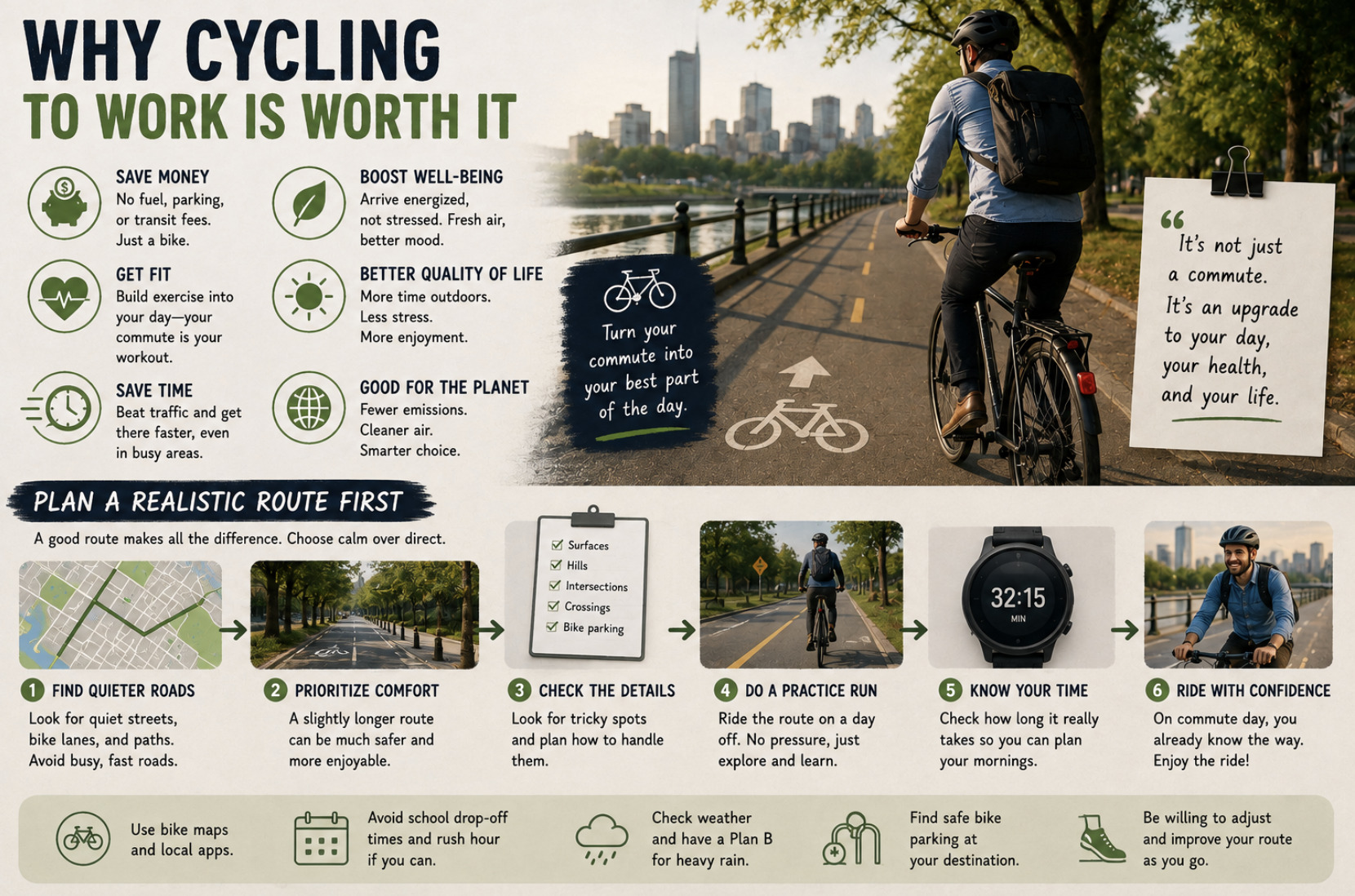
Why cycling to work is worth it
Before the practical steps, it helps to know what you're gaining, because the benefits of bike commuting are substantial and they're what will keep you going. The most immediate is money: cycling to work eliminates fuel costs, parking fees, and transit fares, and beyond the small cost of maintaining a bike, it's essentially free transportation. Over months and years, that adds up to real savings, effectively paying you to travel. For many people, the financial case alone justifies the switch, and it's a benefit you feel every single week.
But the advantages go well beyond cost. Cycling to work builds exercise directly into your day, so you get fit without having to carve out separate time for the gym — your commute becomes your workout, which is a powerful solution to the common problem of never finding time to be active. It's often faster than driving or transit in congested areas, where a bike can move through traffic that leaves cars sitting still, so you may actually arrive sooner. And there's a real quality-of-life benefit: arriving energized rather than stressed from traffic, spending time outdoors, and starting and ending your workday with movement instead of frustration. Many bike commuters find it transforms their relationship with the daily journey, turning dead, stressful time into something genuinely good. Understanding these benefits matters, because on the mornings when starting feels like effort, remembering why you're doing it is what gets you on the bike.
Plan a realistic route first
The most important first step, and the one that makes everything else easier, is planning a good route — because the route can make or break your experience as a beginner. The key insight is that the best cycling route is often not the same as the best driving route. The roads you'd take in a car are frequently busy, fast, and unpleasant or intimidating on a bike, whereas a route on quieter streets, bike lanes, and paths may be far more comfortable, even if it's slightly longer. As a beginner especially, choosing calm, low-traffic roads over the direct-but-busy option makes the ride vastly more enjoyable and less stressful, which is what keeps you coming back.
Take time to work out a route that favors quieter roads and dedicated cycling infrastructure where it exists, rather than simply following the way you'd drive. A little planning here pays off enormously, because a comfortable route removes one of the biggest sources of beginner anxiety — riding among heavy, fast traffic. It's worth genuinely researching your options and being willing to trade a bit of extra distance for a much more pleasant and safe ride. And crucially, do a practice run before your first real commute: ride the route on a day off, when you're not under time pressure, to learn the way, discover any tricky spots, and find out how long it actually takes. This removes the uncertainty and nerves from your first commute, so that when you ride to work for real, you already know exactly where you're going and how long you need. Preparation turns a daunting unknown into a familiar, manageable trip.
Get the essential gear (and don't overthink it)
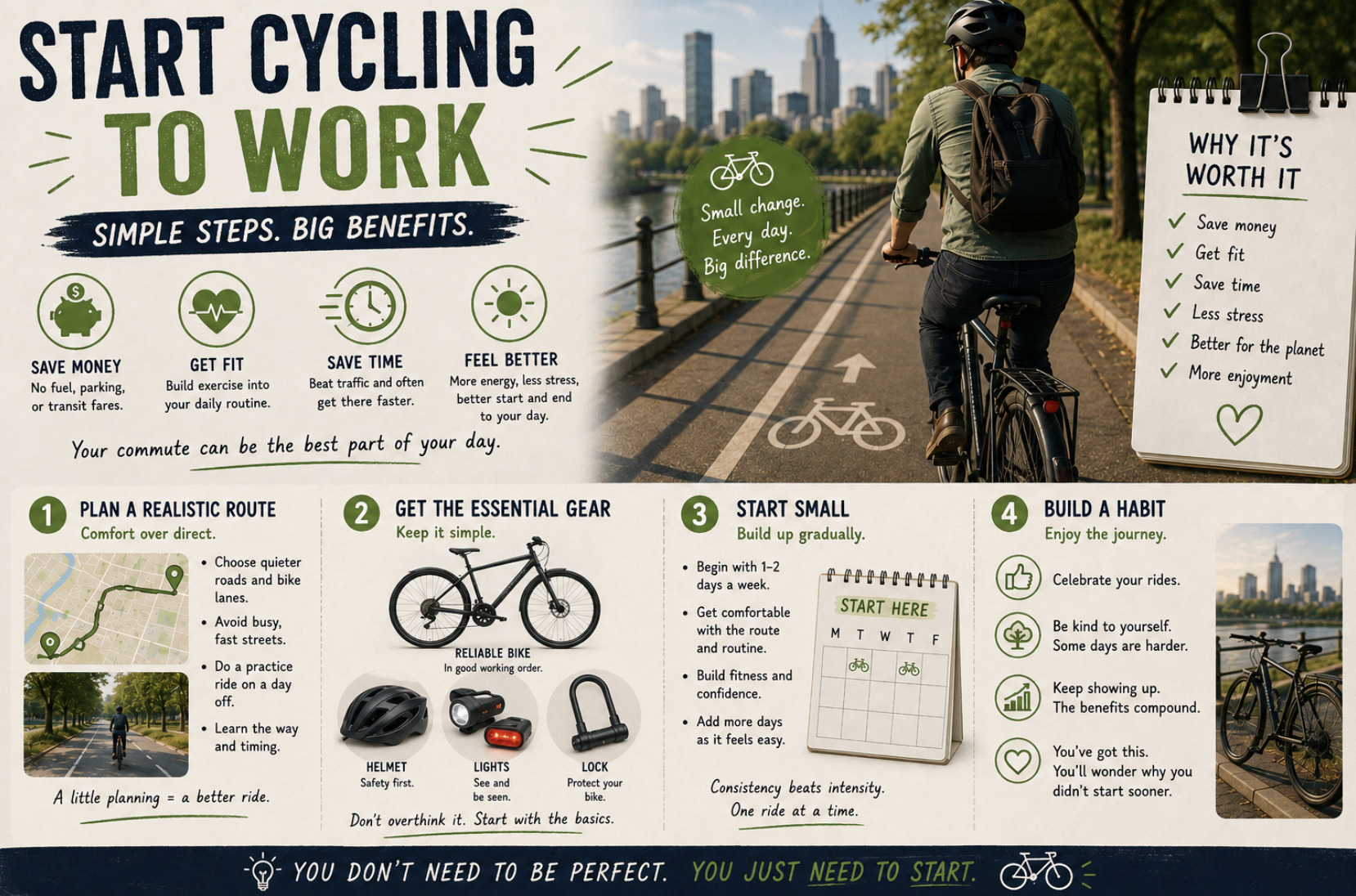
A common thing that stops beginners is the belief that they need a lot of expensive equipment before they can start — but the truth is you need only a few essentials, and you shouldn't overthink it. The core items are a reliable bike in good working order, a helmet for safety, lights so you can see and be seen (essential if you'll ever ride in the dark or low light), and a decent lock to secure your bike at work. That's genuinely enough to begin. You don't need a high-end bike, special clothing, or a pile of accessories to be a bike commuter; you need something that works and the basics that keep you safe and legal.
The reason this matters is that gear anxiety is a real barrier that keeps people from ever starting. It's easy to fall into thinking you must research and buy the perfect setup first, and that research becomes another form of delay. In reality, almost any bike in decent condition will get you to work, and you can start with modest, affordable equipment and upgrade later only if and when you feel the need. Make sure your bike is safe and functioning — brakes, tires, and gears in good order — add a helmet, lights, and a lock, and you're ready. As you gain experience, you'll learn what, if anything, would make your rides better, and you can add it then. But the beginning requires very little, and treating it as if it requires a lot is one of the main reasons people stay stuck at the thinking-about-it stage instead of riding.
Start small and build up gradually
The final and perhaps most important principle for successfully becoming a bike commuter is to start small rather than committing to riding every day immediately. The enthusiastic beginner's instinct is to go all in — cycle to work five days a week starting Monday — but this often leads to burnout, soreness, or discouragement when it proves harder than expected, and then to giving up entirely. A far more sustainable approach is to begin with just one or two days a week, get comfortable with the route and the routine, build your fitness and confidence, and add more days gradually as it starts to feel easy.
This gradual approach works because it lets your body and your habits adapt without being overwhelmed. Starting with a day or two a week means the physical demand is manageable, the logistics are easy to handle, and each successful ride builds your confidence and makes the next one easier. Over time, as your fitness improves and bike commuting becomes familiar and comfortable, riding more days feels natural rather than forced, and you can increase your frequency at whatever pace suits you. There's no rule that you must commute by bike every day to count as a cyclist — even one or two days a week delivers real benefits and is a genuine achievement. Building up slowly turns bike commuting into a lasting habit rather than a brief, exhausting experiment. Be patient with yourself, celebrate the rides you do, and let the habit grow. That's how a curious beginner becomes a confident, regular bike commuter, one comfortable ride at a time.
Frequently asked questions
Do I need to be fit to start cycling to work?
No. You can start at any fitness level by beginning with a manageable route and just one or two days a week, then building up gradually. Bike commuting itself builds your fitness over time, so you don't need to be fit first — the riding gets you fit as you go.
What gear do I actually need to start bike commuting?
Just the essentials: a reliable bike in good working order, a helmet, lights so you can see and be seen, and a lock to secure your bike at work. You don't need an expensive bike or special clothing to begin. Start with the basics and upgrade later only if you find you want to.
How do I choose a route for cycling to work?
Favor quieter roads, bike lanes, and paths rather than the busy roads you'd drive on, even if the cycling route is slightly longer. The most direct driving route is often stressful on a bike. Do a practice ride on a day off to learn the way, spot tricky sections, and time it.
How many days a week should I cycle to work as a beginner?
Start with just one or two days a week rather than every day. This lets your body and routine adapt, builds confidence with each ride, and prevents burnout. As it starts to feel easy, add more days gradually. Even one or two days a week delivers real benefits.

Daniel Hughes
Sustainability & Policy Correspondent
Daniel is interested in how environmental policy translates into real urban change. He specializes in sustainable mobility, climate-focused city planning, and the political frameworks behind transport systems. His writing brings together data, policy analysis, and on-the-ground impact, offering a clear view of how sustainability initiatives affect everyday urban life.
Advertise With Toronto Union 24
Reach over 500,000 engaged Canadian readers monthly. Premium placements available for Q2 2026.
Learn More Noah Bennett