
How to Store and Charge an E-Bike Battery in a Toronto Winter
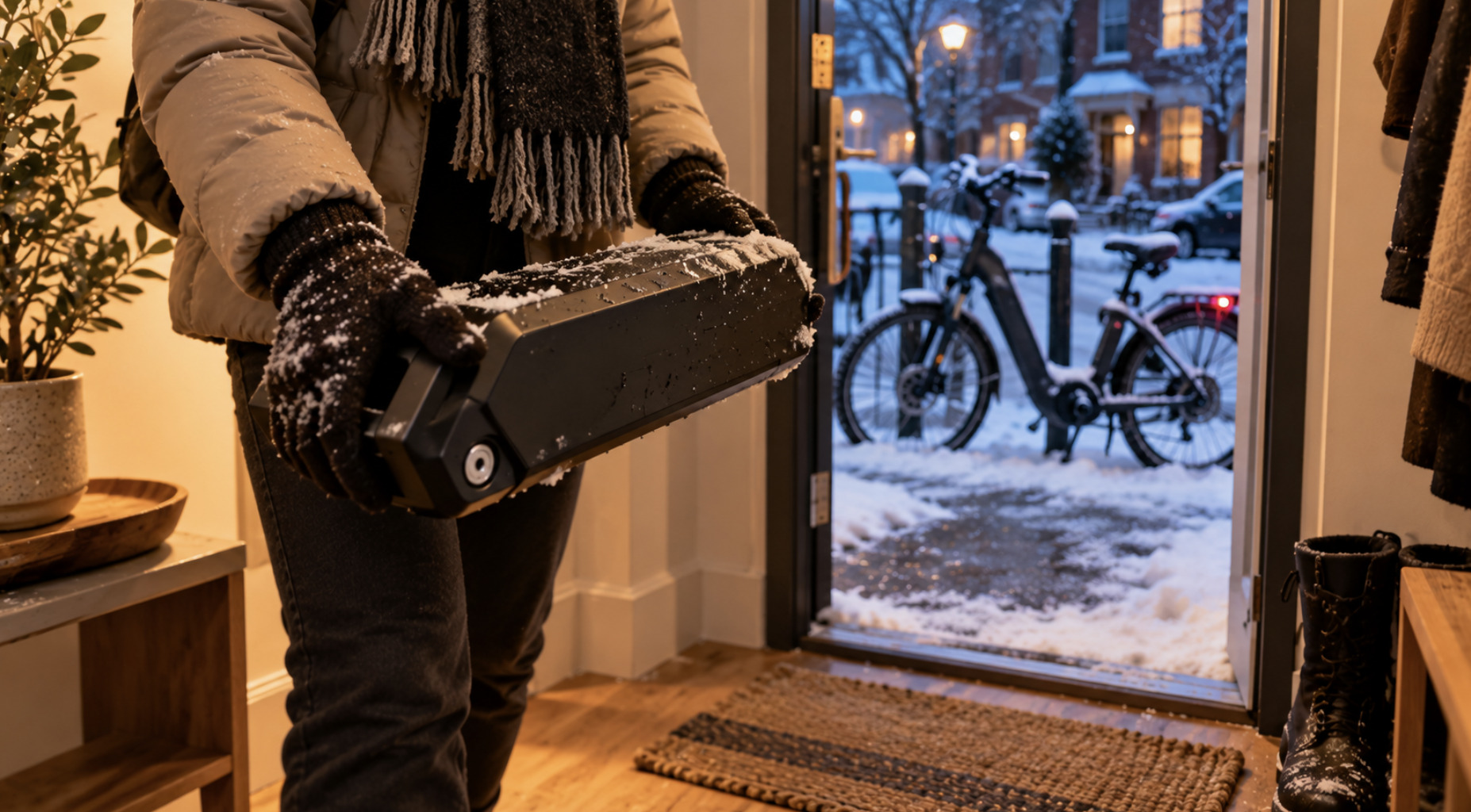
The short version: keep the battery indoors, charge it only once it is at room temperature, and if the bike will sit for weeks, store the battery partly charged rather than full or empty. Cold weather temporarily reduces the range you get from a lithium-ion battery, and that is normal. Charging a battery that is still below freezing is a different matter: it can cause lasting damage, and most quality batteries are designed to refuse it. Most of the real risk in winter comes from how and where batteries are charged and stored, not from riding in the cold.
Toronto has particular reasons to get this right. By early September 2026, Toronto Fire Services had already responded to more than 90 fires involving lithium-ion batteries this year, many of them in e-bikes and e-scooters. In September, Fire Chief Jim Jessop described these fires as the biggest fire safety risk in the city. And from November 15, e-bikes are once again banned from the TTC until April 15, which changes how many riders get around and where their bikes spend the night.
What cold actually does to a battery
A lithium-ion battery works through chemical reactions, and those reactions slow down in the cold. As the temperature drops, the battery's internal resistance rises, so it delivers less usable energy and power. That is why the same battery that easily handles your commute in September can show a lower charge level sooner on a January morning.
This loss is mostly temporary. Once the battery warms back up, its capacity returns. A shorter range on a cold day is not, by itself, a sign that the battery is damaged.
Some things cold makes worse are not temporary:
Charging below freezing. When a lithium-ion battery is charged while its cells are very cold, lithium can deposit as metal on the anode instead of moving into it normally. This is called lithium plating. It permanently reduces capacity and, in serious cases, can create internal defects that make the battery less safe. That is why manufacturers set a minimum charging temperature. Bosch, for example, says its batteries only allow charging between 0°C and 40°C, and the battery's temperature monitoring blocks charging outside that range. Cheaper or uncertified batteries may not have the same protection.
Condensation. Bringing a battery in from −10°C into a warm apartment can cause moisture to form on and around it, much as it does on cold glasses. When the TTC proposed its winter ban, its staff report pointed to temperature swings in the colder months, and specifically to condensation and lithium plating, as reasons for higher risk. In practice, this is why you should let a cold battery warm up and dry before charging, not plug it in the moment you get home.
Physical damage from winter conditions. Potholes, ice falls, salt and slush all increase the chance that a battery gets knocked, cracked or wet in places where water should not reach. Physical damage is one of the main causes of thermal runaway, the self-sustaining overheating that leads to battery fires.
Where to keep the battery
Indoors, at room temperature, in a dry place. That's the core recommendation from major manufacturers. Bosch's guidance for winter use is to charge and store the battery at room temperature and insert it into the bike just before riding. For long-term storage, it recommends a dry room at room temperature, and its battery guide says never to store it below −10°C or above 60°C.
In Toronto, that rules out a number of common habits:
An unheated garage or shed in January can easily drop below the manufacturer's storage limits on cold nights. Manufacturer guides sometimes say a cool basement or garage is better than a warm living room for long-term storage, but that assumes the space stays above the minimum. In a Toronto winter, an unheated garage often doesn't.
A balcony exposes the battery to cold, snow and freeze-thaw cycles.
A car trunk in winter is cold overnight and can get very hot in summer.
Where the bike lives matters less than where the battery lives. If your e-bike has a removable battery, the bike itself can stay in a garage, a secure bike room or a shed, while the battery comes inside with you.
Inside, choose the location with fire safety in mind:
Somewhere with a working smoke alarm nearby.
Not in a hallway or by the door you would use to escape. If a battery fails, fire officials stress that it can spread fast and leave very little time to get out.
Away from heaters, radiators and direct sunlight, and not on or near flammable materials such as sofas, beds or piles of paper.
On a hard, non-flammable surface.
If you live in a condo or apartment, check your building's rules. Many Toronto buildings now restrict where e-bikes and batteries can be stored and charged, and some ban charging in units or common areas altogether.
How to charge in winter
The safest winter routine looks like this:
Bring the battery inside after the ride. Don't charge it in an unheated garage, on a balcony or on the bike outside.
Let it warm up first. A battery that has been outside in sub-zero weather needs time to reach room temperature and dry off. Give it an hour or two. If it feels cold to the touch, it is not ready.
Use the original charger, or one specifically approved by the battery manufacturer. Mismatched or cheap replacement chargers are a common factor in battery incidents.
Charge where you can see it, not overnight while asleep and not while you are out. Fire services consistently advise against charging unattended.
Unplug when it's done. Don't leave the battery on the charger for days.
Reinsert it just before riding in cold weather, so it starts the ride warm.
Partial charges are fine. Bosch notes that its batteries can be charged at any charge level and that interrupting a charge does not harm them. You don't need to drain the battery fully before charging. Regularly running it to zero is actually harder on the cells.

How to store it if you stop riding for the winter
If you are putting the e-bike away until spring, the battery needs a little preparation.
Store it partly charged. Lithium-ion batteries age fastest when they sit for long periods either full or completely empty. Bosch recommends storing its batteries at 30–60 percent, which corresponds to two or three lit LEDs on its battery indicator. Other manufacturers give similar ranges, so check your own manual.
Remove it from the bike. Even when switched off, some systems draw a small amount of power. A battery left on the bike for months can slowly discharge too far.
Check it periodically. Batteries lose a little charge over time. Look at the level every month or so, and if it drops toward the bottom of the recommended range, top it up following your manufacturer's guidance. A battery that sits empty for months can be permanently damaged, and its management system may refuse to charge it at all.
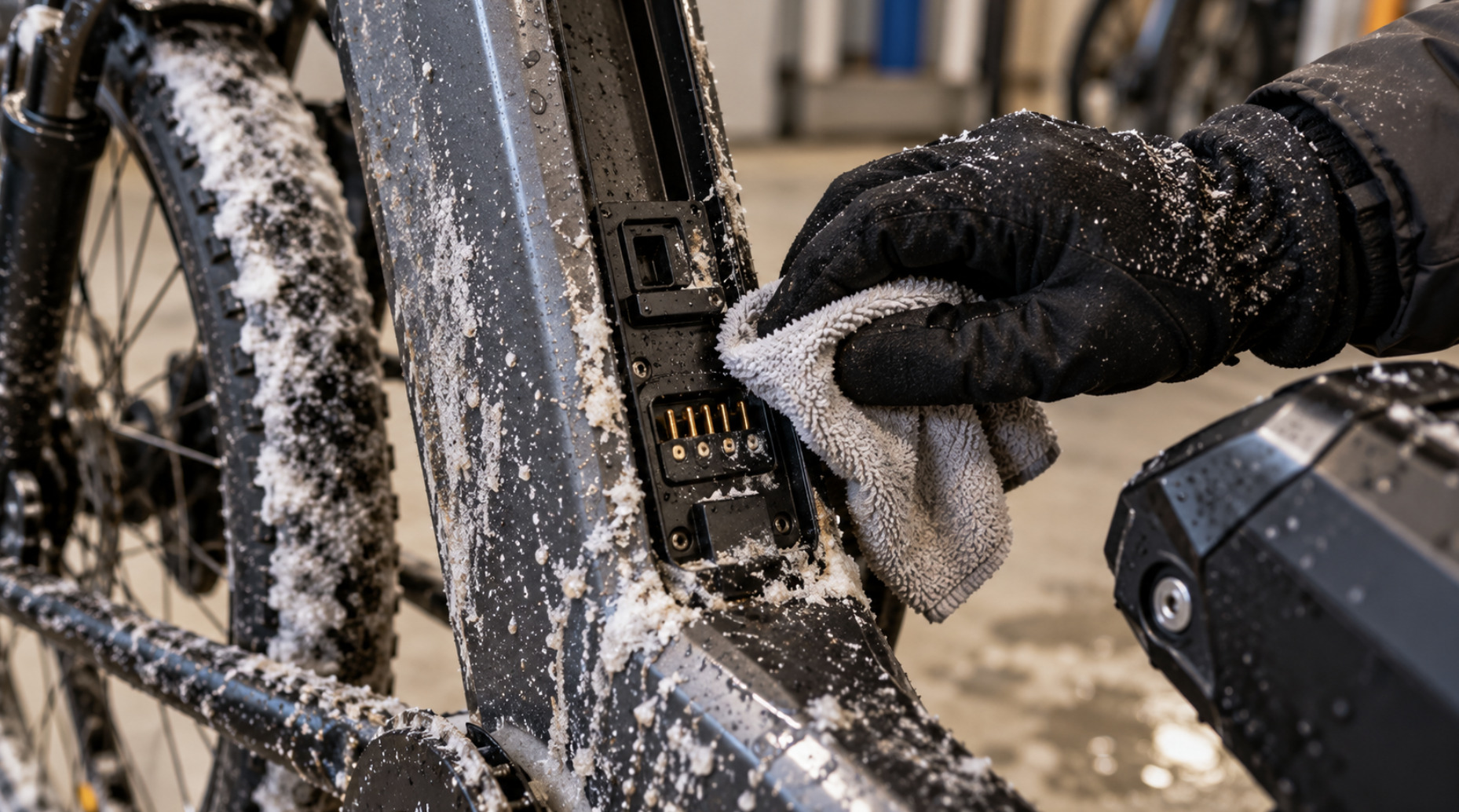
Clean before storing. Wipe away salt and grime from the battery casing and contacts with a dry or slightly damp cloth, following the manufacturer's instructions. Never pressure-wash the battery or the motor area, and never submerge a battery.
Riding in winter without wrecking the battery
If you keep riding through the winter, a few habits help:
Expect less range, and plan for it. On very cold days, plan for noticeably shorter range than in summer, especially with headwinds, snow and slush, which also make the motor work harder. Lower assist levels stretch the range.
Keep the battery warm before you ride. Store and charge it indoors, and fit it at the last minute. Some riders use neoprene battery covers, sold for many systems, which help retain the battery's own warmth on longer rides. They do not heat the battery and are not a substitute for indoor storage.
Watch for road salt. Toronto's winter roads are heavily salted, and salt is corrosive. It affects electrical contacts and connectors as well as the chain and drivetrain. Wipe down the battery contacts and connectors regularly, keep them dry, and have the bike's electrical connections checked at a service visit if you ride all winter.
Some manufacturers explicitly say their e-bikes are not intended for use in snow, ice or road salt. When the TTC reviewed the subway fire that led to its ban, it noted that the manufacturer of the e-bike involved had advised against riding in adverse weather, including where snow, ice or road salt are present. Check what your manufacturer says before planning a winter commute.
Warning signs you should never ignore
Stop using and charging a battery immediately if it:
swells or changes shape,
gets unusually hot during charging or riding,
gives off an unusual smell, smoke, hissing or popping sounds,
leaks any fluid,
has visible cracks, dents or damage after a fall.
If a battery is smoking, hissing or on fire, get out and call 911. Don't try to carry a burning battery outside, and don't try to put it out yourself. Toronto's fire chief has warned that these fires burn extremely hot, release toxic smoke and can reignite hours after they appear to be out.
Never open, repair or modify a battery pack yourself. Fire services in the GTA have pointed to tampering, often to increase range or speed, as a factor in fires. Repairs and cell replacement should be done only by the manufacturer or an authorised service centre. Cheap "rebuilt" batteries from unknown sources are a real risk.
Certification matters more than ever
There is currently no mandatory safety certification for e-bikes or their batteries sold in Canada, a gap Toronto officials have repeatedly criticised. It means certification is your own responsibility as a buyer.
When buying a new e-bike or a replacement battery, look for evidence of testing to recognised safety standards. For e-bike electrical systems, the North American standard is UL 2849. For e-bike and e-scooter batteries specifically, it is UL 2271. In Europe, the equivalent conformity marking is CE. Buy replacement batteries from the original manufacturer or an authorised dealer, and be wary of unbranded batteries sold online at much lower prices.
Certification also matters for regional transit. Metrolinx requires e-bikes brought onto GO Transit to be certified, and staff inspect bikes and attach a tamper-proof seal to those that pass.
The TTC winter ban, in practice
From November 15 to April 15 each year, e-bikes and e-scooters are banned from TTC vehicles and property, including buses' bike racks. The TTC says the ban applies even if the battery is removed, because it is not practical to inspect every battery. Mobility devices used by people with disabilities, such as electric wheelchairs, are not covered by the ban.
The TTC cites greater risk from temperature fluctuations in the colder months, along with a December 2023 battery fire on a subway train, as the reasons for the ban. During the ban, e-bikes can be parked at or near most subway station entrances, and several stations have bike lockers.
For riders who combine an e-bike with transit, this changes the winter plan. The bike may need to spend the day outside, locked at a station, while you work. In that case, take the battery with you if you can, to keep it warm and dry and to deter theft.
A short winter checklist
Before the first cold snap:
Check the manual for your battery's charging and storage temperature ranges.
Find an indoor storage spot with a smoke alarm, away from exits and heat sources.
Make sure you have the original charger.
Check your building's rules on e-bike storage and charging.
Inspect the battery for damage, and have anything suspicious checked by a dealer.
During the winter:
Bring the battery inside after every ride and let it warm up before charging.
Charge only while you are home and awake.
Wipe salt and slush from the battery and contacts.
If you stop riding:
Store the battery at the manufacturer's recommended charge level (often 30–60 percent).
Keep it indoors, dry, and away from extreme cold.
Check the level monthly and top up if it drops low.
A lithium-ion battery that is stored and charged correctly will come out of a Toronto winter in good shape. Most of the damage, and almost all of the danger, comes from the habits that are easiest to fall into in cold weather: charging it cold, leaving it in the garage, or plugging it in overnight and going to bed.

Daniel Hughes
Sustainability & Policy Correspondent
Daniel is interested in how environmental policy translates into real urban change. He specializes in sustainable mobility, climate-focused city planning, and the political frameworks behind transport systems. His writing brings together data, policy analysis, and on-the-ground impact, offering a clear view of how sustainability initiatives affect everyday urban life.
Advertise With Toronto Union 24
Reach over 500,000 engaged Canadian readers monthly. Premium placements available for Q2 2026.
Learn More Liam Carter